
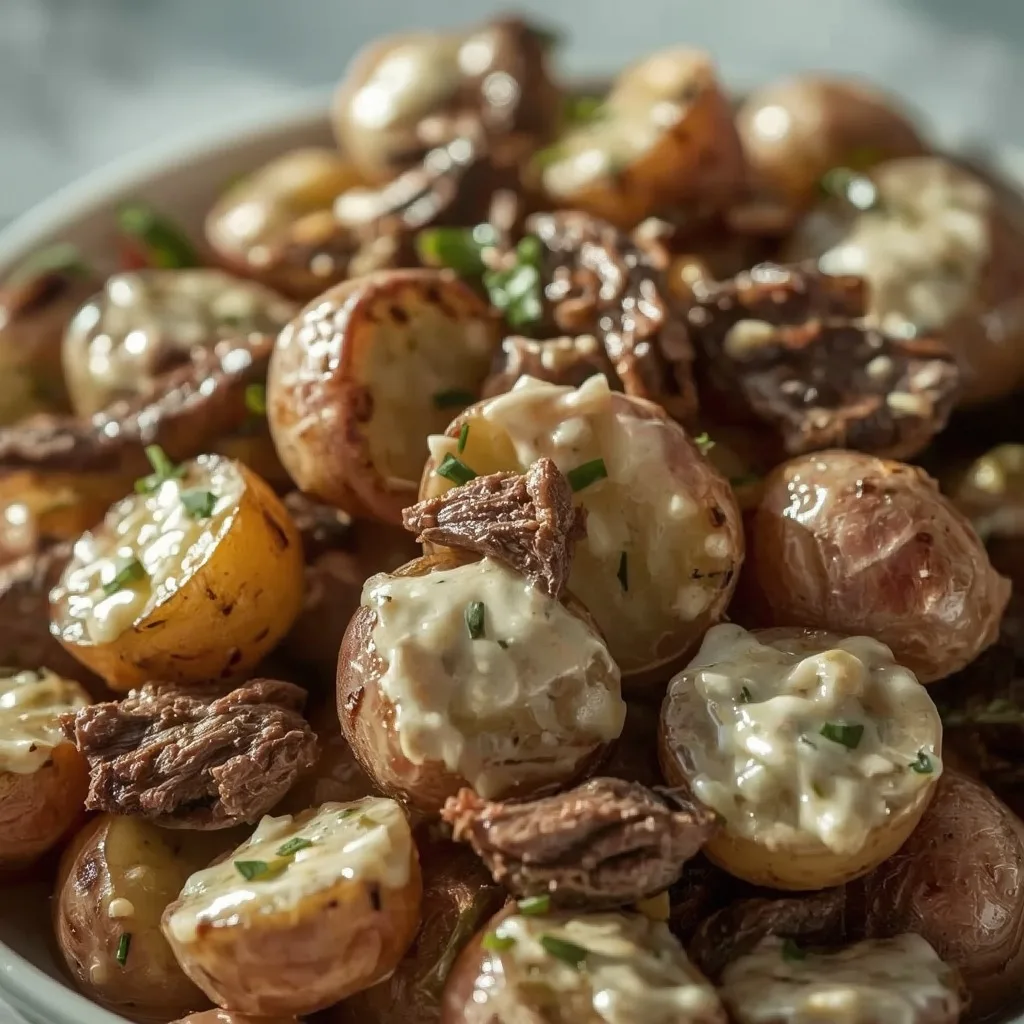
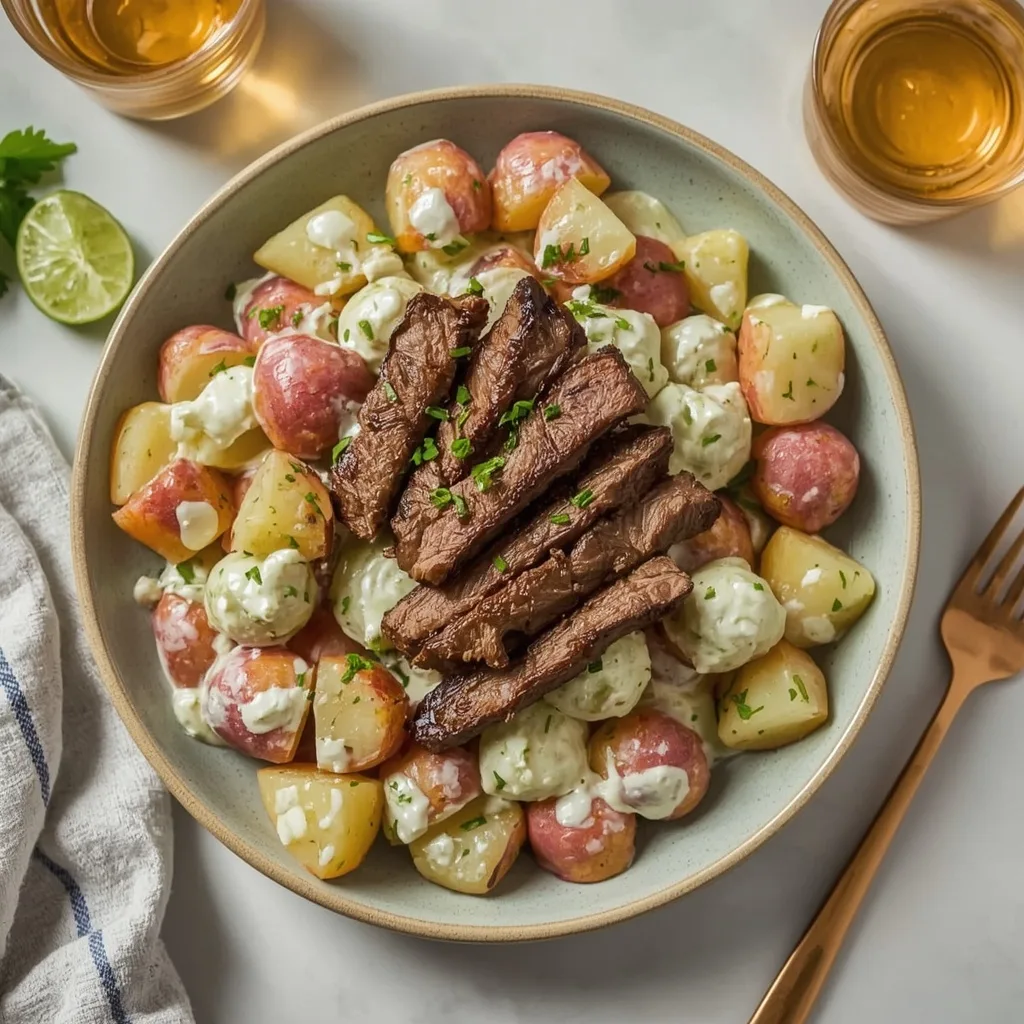
This High Protein Steakhouse Potato Salad takes everything you love about a classic steakhouse side and turns it into a full meal. Roasted red potatoes get tossed with a creamy Greek yogurt dressing, seared steak strips, sharp cheddar, and crispy bacon for a dish that’s rich, tangy, and deeply satisfying. It walks the line between a hearty side and a main course that stands on its own.
You can have it on the table in about 60 minutes from start to finish, and I’d call it intermediate territory — mostly because of the steak searing. Each serving delivers a serious 40g of protein, which makes it perfect for post-workout dinners, backyard cookouts, or meal prep that actually keeps you full. The one step that needs your attention is getting that steak crust right without overcooking the center.
What is High Protein Steakhouse Potato Salad?
This dish reimagines the classic American potato salad by swapping out heavy mayo for a lighter, tangier base and loading it with steakhouse-inspired ingredients. Instead of the typical cold, mustard-heavy picnic version, you get warm roasted potatoes, seared beef, bacon, and cheese all folded together in one bowl. The name says it all — it’s the flavor profile of a steakhouse dinner, but in a single, practical dish.
The roots of this recipe come from the steakhouse tradition of loaded baked potatoes and wedge salads. Red potatoes give it a buttery texture that holds up well to roasting, while the Greek yogurt dressing keeps things creamy without weighing you down. It’s American comfort food at its finest, but with a protein profile that makes it genuinely functional for everyday eating.
Why You’ll Love This Recipe
This one earned a permanent spot in my dinner rotation for a handful of reasons.
- Protein-packed — With 40g per serving, this salad actually functions as a main course. The steak, bacon, cheddar, and Greek yogurt all contribute to that impressive number.
- Bold flavors — The tangy dressing cuts through the richness of the beef and bacon, while the roasted potatoes add a slightly sweet, nutty note. Every bite hits multiple flavor points.
- Make-ahead friendly — The flavors actually deepen overnight in the fridge. You can prep this a day ahead and it’ll taste even better the next day, cold or reheated.
- Versatile serving temperature — Serve it warm right after assembling, or chill it for a cold salad experience. Both versions work beautifully, which is rare for a dish like this.
- Restaurant quality at home — That perfect sear on the steak and crispy bacon gives you that steakhouse feel without the markup. It’s a fraction of the cost of eating out.
- Beginner-accessible technique — While the steak searing needs some attention, the rest of the recipe is simple roasting and mixing. Anyone can nail this with a thermometer.
Ingredients Needed to Make High Protein Steakhouse Potato Salad
Here’s what you’ll need to gather before you start — every ingredient plays a specific role in building the flavor and texture of this dish.
For the Potatoes
- 2 lb (900g) red potatoes, scrubbed and cut into 1-inch cubes — Red potatoes hold their shape during roasting better than other varieties. Their thin skins add texture and don’t need peeling. Look for firm potatoes without any green spots.
- 2 tbsp olive oil — This coats the potatoes before roasting, helping them crisp up in the oven. Use a good quality extra-virgin olive oil here, though any neutral oil will work in a pinch.
- 1 tsp kosher salt — Kosher salt has a cleaner, less sharp taste than table salt. If you use table salt, reduce the amount to about 3/4 teaspoon.
- 1/2 tsp ground black pepper — Freshly cracked pepper gives a brighter, more aromatic flavor than pre-ground. It adds that classic steakhouse seasoning note.
For the Steak and Bacon
- 1 lb (450g) sirloin steak, trimmed of excess fat — Sirloin offers great beef flavor with a reasonable price tag. Flank steak also works beautifully here if you prefer — just slice it thin against the grain. Pat it dry before seasoning.
- 1 tbsp olive oil — This goes in the skillet for searing the steak. It helps create that brown crust without burning the seasoning.
- 4 slices bacon, cut into 1/2-inch pieces — Bacon adds smoke and richness that ties the whole dish together. Thick-cut bacon works especially well here, giving you bigger, meatier pieces.
- Kosher salt and black pepper for the steak — Season generously on both sides. The steak needs more seasoning than you might expect because it’s being incorporated into a larger dish.
For the Dressing
- 1/2 cup (120g) full-fat Greek yogurt — This is the protein backbone of the dressing, and full-fat is important here for richness. It adds tang and creaminess while keeping the calorie count reasonable. Don’t sub non-fat Greek yogurt — it’ll be too thin.
- 2 tbsp (30g) mayonnaise — A small amount of mayo gives the dressing that classic potato salad mouthfeel without dominating the Greek yogurt. It smooths out the sharpness of the yogurt.
- 1 tbsp (15 ml) Dijon mustard — Dijon adds a sharp, complex kick that cuts through the fat of the steak and bacon. Whole grain mustard works too, but the texture will be different.
- 1 tbsp (15 ml) red wine vinegar — The acidity here brightens everything up. Red wine vinegar brings a fruity tang that pairs well with beef. If you swap for apple cider vinegar, use a touch less.
- 1/2 tsp garlic powder — Garlic powder distributes more evenly than fresh garlic in a cold dressing. It adds savory depth without the raw bite.
- 1/4 tsp onion powder — This rounds out the savory notes in the dressing. Like the garlic powder, it dissolves completely, creating a smooth, evenly seasoned base.
For the Salad Mix-Ins
- 1/2 cup (60g) diced celery, about 2 stalks — Celery brings crunch and freshness that balances the richness of the other ingredients. Dice it small enough that you get a piece in every bite.
- 1/4 cup (40g) finely diced red onion — Red onion adds a mild bite and beautiful color. Finely dicing keeps it from overpowering the dish. If you’re sensitive to raw onion, rinse the diced pieces under cold water first.
- 4 oz (113g) sharp cheddar cheese, cut into 1/4-inch cubes — Sharp cheddar stands up to the bold flavors here. Cubing it rather than shredding it means you get distinct pockets of gooey cheese throughout the salad. Aged cheddar with a bit of crystallization adds even more flavor.
- 2 tbsp (8g) fresh chives, chopped for garnish — Chives add a mild onion flavor and a pop of green color at the end. If you can’t find them, finely sliced scallion greens work as a substitute.
Equipment Needed
You don’t need a full professional kitchen setup for this recipe — just a few solid pieces that do their job well.
- Large baking sheet — You need room to spread the potatoes in a single layer so they roast rather than steam. A rimmed baking sheet is essential. Line it with parchment paper for easy cleanup.
- Cast-iron skillet — This is the best tool for getting a proper sear on the steak. The heavy pan holds heat well and creates that beautiful brown crust. A heavy stainless steel skillet works too, though it won’t hold heat quite as evenly.
- Instant-read thermometer — This is non-negotiable for the steak. You want an accurate reading to hit that 130°F (54°C) target for medium-rare. Getting it wrong on either side ruins the texture of the whole dish.
- Large mixing bowl — You need a big bowl to fold everything together without crushing the potatoes. Go bigger than you think you’ll need — it makes tossing much easier.
- Slotted spoon — This is for removing the bacon from the skillet while leaving the rendered fat behind. A spider strainer also works perfectly.
Instructions to Make High Protein Steakhouse Potato Salad
The process moves in stages — roast the potatoes while searing the steak, then build the dressing and fold everything together. Work through each step in order and you’ll have a restaurant-worthy dish in about an hour.
Step 1: Roast the Potatoes
Preheat your oven to 425°F (218°C) and line a large baking sheet with parchment paper. Toss the cubed potatoes with 2 tablespoons of olive oil, 1 teaspoon kosher salt, and 1/2 teaspoon black pepper in a large bowl until every piece is well coated.
Spread the potatoes in a single layer on the sheet. If they’re crowded, they’ll steam instead of crisp up — use two sheets if you need to. Roast for 25-30 minutes, flipping halfway, until the potatoes are golden brown and easily pierced with a fork. Set them aside to cool slightly while you work on the steak.
Step 2: Sear the Steak
Pat the sirloin dry with paper towels — this is crucial. Dry meat sears better because the surface heat isn’t lost to evaporating moisture. Season both sides generously with salt and pepper, then heat your cast-iron skillet over medium-high until it just starts to smoke.
Add the remaining tablespoon of olive oil and swirl to coat the pan. Carefully lay the steak in the skillet and leave it alone for 3-4 minutes. You want a deep brown crust to form. Flip it and cook another 3-4 minutes for medium-rare, or until the internal temperature hits 130°F (54°C). For medium, aim for 140°F (60°C). Check with your instant-read thermometer.
Step 3: Rest the Steak and Cook the Bacon
Transfer the steak to a cutting board and let it rest for at least 10 minutes. This isn’t optional — resting lets the juices redistribute throughout the meat. If you cut it too early, those juices end up on the cutting board instead of in your salad.
While the steak rests, add the bacon pieces to the same skillet and cook over medium heat, stirring occasionally, for 6-8 minutes until crisp and browned. Remove with a slotted spoon and drain on a paper towel-lined plate. Don’t discard that bacon fat entirely — you can use a bit of it to brush over the potatoes if you want an extra flavor boost.
Step 4: Make the Dressing
In a small bowl, whisk together the Greek yogurt, mayonnaise, Dijon mustard, red wine vinegar, garlic powder, and onion powder. Add a pinch of salt and pepper. The dressing should be thick and creamy — if it seems too thick, add a teaspoon of milk or a splash more vinegar.
This dressing is the flavor anchor of the whole dish. It’s tangy enough to cut through the richness of the beef and bacon, but creamy enough to coat the potatoes well. Taste it and adjust the seasoning before you add it to the salad.
Step 5: Slice the Steak Against the Grain
Once the steak has rested, place it on your cutting board and look at the direction of the muscle fibers — they’ll run in visible lines. Slice thinly against those lines, cutting perpendicular to them. This shortens the muscle fibers and makes each bite tender rather than chewy.
Cut the slices into bite-sized strips if they’re long. Keep the slices thin — about 1/4 inch — so they distribute evenly through the salad. You should get nice pieces in nearly every forkful.
Step 6: Combine All Ingredients
In your large mixing bowl, combine the roasted potatoes (they should still be slightly warm), the sliced steak, crispy bacon, diced celery, red onion, and cheddar cheese cubes. Gently fold these together, being careful not to break up the potatoes too much. A silicone spatula works best here.
Pour the dressing over the top and toss gently until everything is evenly coated. Taste it and adjust with more salt, pepper, or a splash of vinegar if needed. The salad should have a bold, tangy, savory profile — don’t be afraid to season boldly.
Step 7: Rest Before Serving
Let the salad stand at room temperature for about 10 minutes. This gives the flavors time to meld together and lets the potatoes absorb some of the dressing. Garnish with fresh chopped chives right before serving.
Serve warm for the full steakhouse experience, or cover and refrigerate for a chilled version. Both are delicious, though I lean warm.
What Went Wrong and How I Fixed It
I’ve made this recipe more times than I can count, and a few things tripped me up in the beginning. Here’s what I learned the hard way.
- Overcrowded potatoes — The first time I made this, the potatoes came out soft and pale instead of crisp. They were too close together on the sheet. Now I always use two baking sheets if needed to keep everything in a single layer.
- Steak cooked past medium — I left the steak on the heat a bit too long once and it came out well-done. The texture was tough and chewy in the salad. Get the thermometer out and pull the steak at 130°F (54°C) — it continues cooking as it rests.
- Sliced the steak with the grain — The meat was tender when it came off the pan, but once sliced the wrong direction it turned chewy. Take a moment to identify the grain direction before cutting.
- Dressing absorbed too quickly — Adding the dressing while the potatoes were extremely hot made them soak it all up too fast, leaving the salad dry. Let the potatoes cool for about 10 minutes before combining with everything else.
- Flavors flat on day one — Right after making it, the salad can taste slightly one-dimensional. Letting it sit overnight in the fridge makes a huge difference — the flavors deepen and blend beautifully.
What Do I Serve With High Protein Steakhouse Potato Salad?
This salad is filling enough to be a main course, but it also shines next to other dishes. Here are some pairings that work especially well.
- Grilled asparagus — Lightly charred asparagus with a squeeze of lemon cuts through the richness of the salad. The crisp texture contrasts nicely with the creamy potatoes.
- A crisp green salad — A simple side salad with a light vinaigrette balances the heaviness. Go with something fresh like baby spinach or arugula to keep things bright.
- Garlic bread — You’ll want something to soak up the extra dressing from the bowl. Warm garlic bread does the job perfectly and fits the steakhouse vibe.
- Red wine — A medium-bodied red like a Malbec or Cabernet Sauvignon pairs beautifully with the beef and cheddar. The tannins cut through the fat nicely.
- Grilled corn on the cob — Charred corn with butter and a sprinkle of chili powder brings a touch of sweetness that complements the savory salad. It’s a classic summer pairing.
- Roasted Brussels sprouts — The slightly bitter, caramelized edges of Brussels sprouts contrast well with the creamy dressing and the rich beef.
Pro Tips to Make Perfect High Protein Steakhouse Potato Salad
A few small adjustments can take this dish from good to genuinely exceptional. These are the tricks I’ve picked up along the way.
- Pat the steak completely dry — The drier the surface, the better the sear. Moisture on the steak creates steam, which prevents that deep brown crust from forming. Use paper towels and press firmly.
- Let the steak rest a full 10 minutes — This feels like forever when you’re hungry, but it’s essential. Slicing too early releases the juices and leaves you with dry meat in a wet salad.
- Keep the potatoes slightly warm — Combining warm potatoes with the dressing lets them absorb just enough flavor without turning mushy. Let them cool for 5-10 minutes after roasting, then assemble.
- Cube the cheddar rather than shredding — Little pockets of cheese melt slightly into the warm salad, creating amazing bites of flavor. Shredded cheese just disappears into the dressing.
- Taste and adjust before serving — Potato salads always need more seasoning than you expect. The potatoes absorb salt, so taste the finished salad and add a pinch more if needed.
- Consider making it a day ahead — The flavors genuinely improve overnight. If you can, assemble the salad the day before you need it and let it sit in the fridge. Just add the chives right before serving.
- Save the bacon fat — Drizzle a teaspoon of rendered bacon fat over the warm potatoes before adding everything else. It adds a subtle smokiness that’s absolutely worth the extra step.
Variations of High Protein Steakhouse Potato Salad
Once you’ve made this the traditional way, try one of these spins to keep things interesting. Each one brings a slightly different personality to the dish.
- Chicken version — Swap the sirloin for grilled chicken breast and reduce the total time. Cook the chicken with the same searing method, or use rotisserie chicken to simplify even further. You’ll still get great protein, just a lighter flavor.
- Blue cheese crumble — Replace the sharp cheddar with crumbled blue cheese. The pungent tang of blue cheese amplifies the steakhouse vibe dramatically. Gorgonzola also works well here.
- Spicy Southwest — Add a diced jalapeño, some smoked paprika, and a squeeze of lime juice to the dressing. Swap the red onion for pickled red onions if you have them. The acidity and heat make this version unforgettable.
- Lower carb option — Replace the red potatoes with roasted cauliflower florets. Roast them the same way and they’ll absorb the dressing beautifully. You’ll cut the carbs significantly while keeping the texture.
- Extra protein boost — Top each serving with a poached or fried egg. The runny yolk mixes into the salad and adds another 6g of protein per serving. It turns this into a fully indulgent brunch dish.
- Herb-forward twist — Use fresh dill and parsley in place of the chives. Dill especially pairs wonderfully with the Greek yogurt. It adds a freshness that makes the whole dish feel lighter.
How Do I Store High Protein Steakhouse Potato Salad Leftovers?
Storing this salad properly keeps it tasting great for several days. Here’s what I do with leftovers.
- Airtight container — Transfer the salad to an airtight container within 2 hours of serving. Press a piece of plastic wrap directly onto the surface to keep the dressing from drying out.
- Refrigerator storage — Keeps well for up to 4 days in the fridge. The flavors actually deepen overnight, making day two even better than day one.
- Keep the garnish separate — Add fresh chives only when serving. Chopped herbs reheat poorly and turn soggy when stored in the salad for days.
- Skip freezing — This dish does not freeze well. The creamy dressing separates and the potatoes turn grainy and watery after thawing. Make only what you’ll eat within four days.
- Label and date — If you’re meal-prepping, write the date on the container so you know when it needs to be eaten. It’s easy to lose track in a busy fridge.
How Do I Reheat High Protein Steakhouse Potato Salad Leftovers?
You can enjoy this salad warm or cold, so reheating is entirely optional. Here are your best options if you want it warm.
- Microwave — Place a portion in a microwave-safe bowl and heat on medium power for 1-2 minutes. Stir halfway through. Be careful not to overheat — the dressing can separate if it gets too hot.
- Skillet — Heat a skillet over medium heat and add the salad. Cook for 5-7 minutes, stirring occasionally, until warmed through. Add a splash of milk or extra Greek yogurt if it looks dry.
- Oven — Spread the salad in a baking dish and cover with foil. Heat at 350°F (177°C) for about 10-15 minutes. This method keeps things more evenly heated than the microwave.
FAQs
Can I freeze High Protein Steakhouse Potato Salad?
No, I don’t recommend freezing this dish. The creamy Greek yogurt dressing will separate and become watery when thawed, and the potatoes will turn grainy. Make it fresh and eat it within 4 days for the best experience.
How long does High Protein Steakhouse Potato Salad last in the fridge?
Stored in an airtight container, this salad stays fresh for up to 4 days. The flavors actually improve over the first 24-48 hours as the dressing soaks into the potatoes and the ingredients meld together. Just add fresh chives before serving.
Can I make this without the steak?
Absolutely. Omit the steak entirely for a vegetarian side dish, and you’ll still have plenty of protein from the Greek yogurt, cheese, and bacon. Alternatively, swap in a meat alternative or extra roasted mushrooms for a heartier texture.
What’s the best way to get a perfect sear on the steak?
Pat the steak completely dry, season generously, and use a heavy skillet heated until it just begins to smoke. Place the steak in the pan and don’t move it for 3-4 minutes. Letting it rest after cooking is just as important as the searing itself.
Can I use a different type of potato?
Yes, but red potatoes work best because they hold their shape during roasting. Yukon Gold potatoes are a good substitute, with a similar waxy texture. Stay away from russets — they’re too starchy and will fall apart.
Is this salad best served warm or cold?
Both work incredibly well, which is part of why I love this recipe. Warm, it feels like a hearty steakhouse side. Cold, it becomes a satisfying summer meal-prep option. Try both and see which you prefer.
Try These Recipes
Final Words
This High Protein Steakhouse Potato Salad has become one of my most-requested dishes, and it’s easy to see why. It brings together the comforting flavors of a classic steakhouse dinner with the practicality of a one-bowl meal that keeps you full for hours.
Give it a try this week — I think you’ll be genuinely surprised by how much you enjoy it. Whether you serve it warm right off the stove or meal-prep it for the week ahead, it delivers on flavor, protein, and satisfaction every single time.
PrintHigh Protein Steakhouse Potato Salad

This isn’t your average picnic potato salad. It features roasted red potatoes tossed in a creamy, tangy dressing made with Greek yogurt and a touch of mayonnaise, then loaded with seared steak strips, sharp cheddar, and crispy bacon for a protein-packed punch. The combination of warm potatoes, cool dressing, and savory mix-ins creates a rich, hearty side dish that can easily stand alone as a main course.
- Prep Time: 20
- Cook Time: 40
- Total Time: 60
- Yield: 4 1x
- Category: Main Course
- Method: Roasting and Stovetop
- Cuisine: American
Ingredients
- 2 lb (900g) red potatoes, scrubbed and cut into 1-inch cubes
- 3 tbsp (45 ml) olive oil, divided
- 1 tsp kosher salt, plus more for seasoning
- 1/2 tsp ground black pepper, plus more for seasoning
- 1 lb (450g) sirloin steak (or flank steak), trimmed of excess fat
- 4 slices bacon (about 4 oz / 113g), cut into 1/2-inch pieces
- 1/2 cup (120g) full-fat Greek yogurt
- 2 tbsp (30g) mayonnaise
- 1 tbsp (15 ml) Dijon mustard
- 1 tbsp (15 ml) red wine vinegar
- 1/2 tsp garlic powder
- 1/4 tsp onion powder
- 1/2 cup (60g) diced celery (about 2 stalks)
- 1/4 cup (40g) finely diced red onion
- 4 oz (113g) sharp cheddar cheese, cut into 1/4-inch cubes (about 1 cup)
- 2 tbsp (8g) fresh chives, chopped (for garnish)
Instructions
- Preheat your oven to 425°F (218°C). Line a large baking sheet with parchment paper or a silicone mat for easy cleanup. In a large bowl, toss the cubed red potatoes with 2 tablespoons of olive oil, 1 teaspoon kosher salt, and 1/2 teaspoon black pepper until evenly coated.
- Spread the potatoes in a single layer on the prepared baking sheet, ensuring they are not overcrowded; overcrowding will cause them to steam rather than roast. Roast for 25-30 minutes, flipping halfway through, until the potatoes are golden brown and fork-tender. Set aside to cool slightly while you prepare the other components.
- While the potatoes roast, pat the sirloin steak dry with paper towels. Season both sides generously with kosher salt and black pepper. Heat a large cast-iron skillet over medium-high heat until it begins to smoke slightly. Add the remaining 1 tablespoon of olive oil, swirling to coat the pan.
- Carefully place the steak in the hot skillet. Sear without moving for 3-4 minutes until a deep brown crust forms. Flip the steak and cook for another 3-4 minutes for medium-rare, or until it reaches an internal temperature of 130°F (54°C) for medium-rare, 140°F (60°C) for medium. Use an instant-read thermometer to check doneness.
- Transfer the steak to a cutting board and let it rest for at least 10 minutes. Resting allows the juices to redistribute, keeping the meat moist and tender. While the steak rests, cook the bacon in the same skillet over medium heat, stirring occasionally, until crisp and browned, about 6-8 minutes. Use a slotted spoon to transfer the bacon to a paper towel-lined plate.
- In a small bowl, whisk together the Greek yogurt, mayonnaise, Dijon mustard, red wine vinegar, garlic powder, and onion powder. Season with a pinch of salt and pepper. This dressing will be tangy, creamy, and thick—perfect for coating the warm potatoes.
- Once the steak has rested, slice it thinly against the grain into bite-sized strips. The grain is the direction of the muscle fibers; slicing against it shortens the fibers, ensuring each bite is tender.
- In a large mixing bowl, combine the roasted potatoes (they should still be slightly warm), the sliced steak, crispy bacon, diced celery, red onion, and cheddar cheese cubes. Gently fold the ingredients together, being careful not to break up the potatoes.
- Pour the dressing over the salad and toss gently until everything is well coated. Taste and adjust seasoning with additional salt, pepper, or a splash of vinegar if needed. The salad should have a bold, tangy, and savory flavor.
- Let the salad stand at room temperature for 10 minutes to allow the flavors to meld. Garnish with fresh chopped chives. Serve warm, or cover and refrigerate to serve chilled. This salad is delicious both ways.
Notes
Storage: Store leftover potato salad in an airtight container in the refrigerator for up to 4 days. The flavors deepen overnight. Freezing: This dish does not freeze well due to the creamy dressing and potatoes; it will become watery and grainy. Reheating: For warm service, reheat individual portions in the microwave on medium power for 1-2 minutes, or in a skillet over medium heat for 5-7 minutes. If reheating, you may want to add a splash of milk or extra Greek yogurt to refresh the creamy texture. For cold service, simply remove from the fridge and let sit for 10 minutes before serving.
Nutrition
- Calories: 620
- Sugar: 4g
- Sodium: 980mg
- Unsaturated Fat: 12g
- Carbohydrates: 38g
- Fiber: 4g
- Protein: 40g
- Cholesterol: 115mg
Keywords: steakhouse potato salad, high protein potato salad, grilled steak potato salad, steak salad, high protein side dish, roasted potato salad, Greek yogurt potato salad, bacon cheddar potato salad, beef potato salad, main course salad