
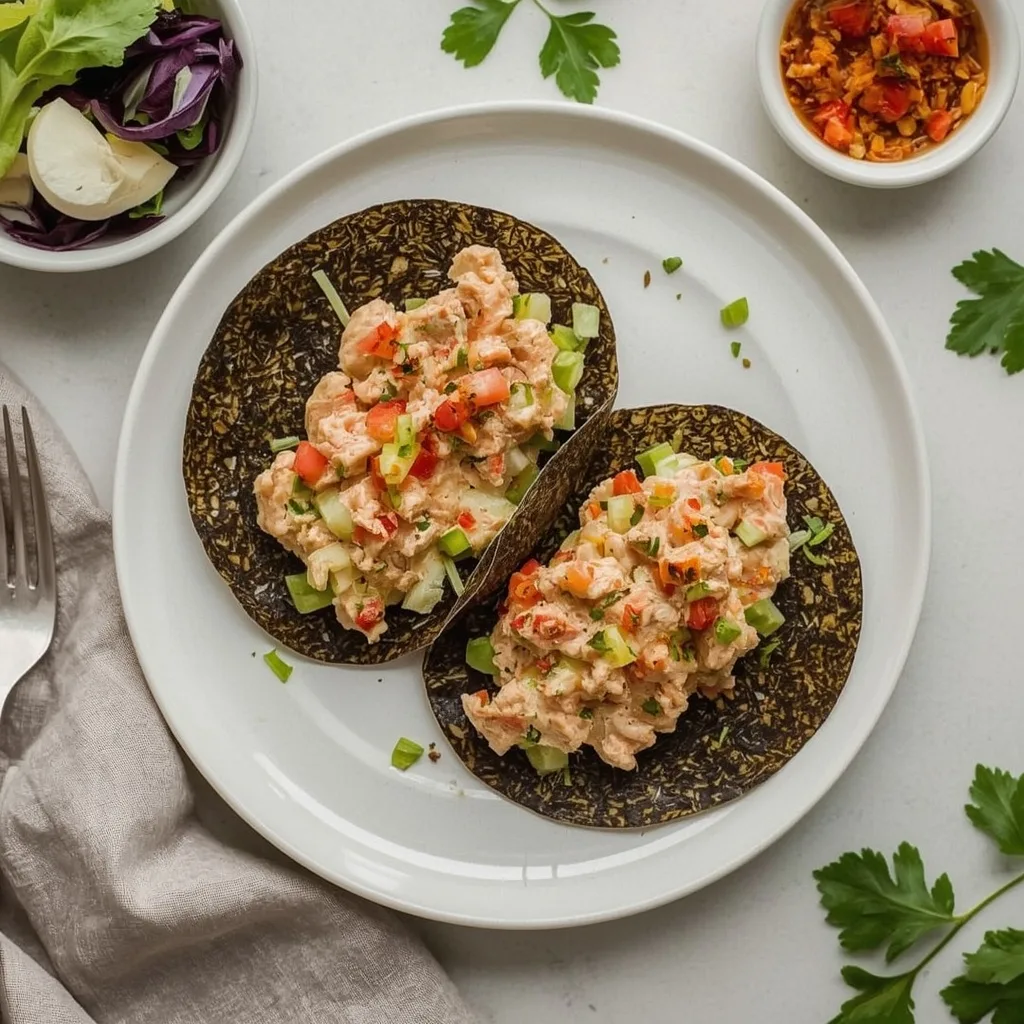
High Protein Tuna Salad Nori Wraps are my new favorite way to turn a pantry staple into something that actually feels special. These crispy, toasted nori sheets hold a creamy tuna salad that gets its tang from Greek yogurt and its crunch from fresh vegetables, creating a savory, umami-packed bite that works for lunch or a quick snack.
You can have these on the table in about 20 minutes from start to finish, making them perfect for busy weekdays. This beginner-friendly recipe makes 4 servings, with each one delivering a solid 29g of protein. The only slightly tricky part is rolling the nori tightly enough to keep everything sealed, but I will walk you through it step by step.
## What is High Protein Tuna Salad Nori Wraps?
This dish takes the familiar comfort of tuna salad and gives it a Japanese-inspired twist by wrapping it in nori, the same seaweed sheets used for sushi. Instead of heavy mayonnaise, the creamy base comes mostly from Greek yogurt, which lightens things up while adding extra protein. The filling stays chunky and satisfying with diced celery, red onion, and bell pepper for texture.
The nori sheets get toasted briefly, which transforms their flavor from slightly fishy to nutty and crisp. When you bite through the seaweed, you get that satisfying crackle before the creamy tuna salad hits your palate. It is a handheld meal that feels a bit like sushi but tastes like your favorite deli sandwich filling.
What makes these wraps so clever is how well the textures work together. The nori provides structure and that ocean-forward savoriness, while the cucumber strips add a refreshing crunch that cuts through the richness of the tuna. The result is a balanced, satisfying wrap that does not leave you feeling heavy.
## Why You’ll Love This Recipe
Here is why these wraps have earned a permanent spot in my weekly rotation.
– Protein punch — You get 29g of protein per serving, thanks to three full cans of tuna plus a double dose of Greek yogurt. That is enough to keep you full for hours without any protein powder in sight.
– No cooking required — The only heat involved is a quick toast of the nori, and even that is optional. This is a true no-cook meal that works even when it is too hot to turn on the stove.
– Meal prep friendly — You can make the tuna salad up to 2 days ahead and keep it in the fridge. When you are ready to eat, just scoop, roll, and go.
– Naturally lower carb — With only 8g of carbohydrates per serving, these wraps fit nicely into a lower-carb lifestyle without feeling like a deprivation meal.
– Customizable texture — The filling hold together well but stays loose enough to adjust. Add more crunch, spice it up with sriracha, or swap the cucumber for whatever is in your crisper drawer.
## Ingredients Needed to Make High Protein Tuna Salad Nori Wraps
You probably have most of these ingredients already, which is exactly why I love this recipe. Here is everything you need to gather before you start.
### The Tuna Salad Base
– 3 cans (5 oz / 142 g each) solid white albacore tuna in water, drained and flaked — Albacore has a milder flavor and firmer texture than chunk light tuna, which works best here. Make sure to drain it really well so your salad does not turn watery.
– 1/2 cup plain nonfat Greek yogurt — This is the protein powerhouse that replaces most of the mayonnaise. It adds creaminess and tang while keeping the calorie count reasonable.
– 1/4 cup full-fat Greek yogurt — The combination of nonfat and full-fat gives you the best of both worlds. The full-fat version adds richness so the salad does not taste lean or flat.
– 2 tbsp mayonnaise — Just enough to give that classic tuna salad mouthfeel. You can use light mayo if you prefer, but a little full-fat goes a long way here.
– 1 tbsp Dijon mustard — This adds a sharp, tangy brightness that cuts through the richness. It also helps emulsify the dressing so everything comes together smoothly.
– 2 tbsp fresh lemon juice (about 1/2 lemon) — Fresh lemon juice wakes up all the flavors. Bottled lemon juice works in a pinch, but fresh really does taste brighter.
### The Crunchy Additions
– 1/4 cup celery, finely diced (about 1 stalk) — Celery gives that classic tuna salad crunch and a slightly savory note. Finely dicing it ensures it disperses evenly throughout the salad.
– 1/4 cup red onion, finely diced — Red onion adds a mild bite and beautiful color. If red onion is too sharp for you, soak the diced pieces in cold water for 5 minutes before adding.
– 1/4 cup red bell pepper, finely diced — The sweetness of red pepper balances the tangy yogurt and mustard. It also adds a nice pop of color against the pale tuna.
– 2 tbsp fresh chives, chopped — Chives bring a delicate onion flavor that does not overpower. If you do not have chives, thinly sliced green onions work beautifully.
– 1/2 tsp kosher salt, plus more to taste — Salt brings everything into focus. Start with the half teaspoon and adjust at the end once you taste the finished salad.
– 1/4 tsp black pepper, freshly ground — Freshly ground pepper has more aroma than pre-ground. A subtle warmth that plays well with the Dijon and lemon.
### The Wraps
– 8 sheets nori (about 8 x 7 inches each) — These are the same sheets used for sushi rolls. Look for them in the Asian foods aisle or online, and make sure they are crisp and not stale.
– 1 medium cucumber, seeded and cut into 3-inch long thin strips (about 2 cups) — Seeding the cucumber prevents the wraps from getting soggy. The strips add crunch and freshness that balances the creamy tuna.
## Equipment Needed
You do not need a sushi kit for this, which is part of why this recipe is so approachable.
– Fine-mesh strainer — This is essential for draining the canned tuna thoroughly. Pressing the tuna against the mesh removes excess liquid that would make your salad soupy.
– Large mixing bowl — You need room to flake the tuna and mix everything without making a mess. Any large bowl you already own will work.
– Sharp knife — A sharp knife makes clean cuts when slicing the wraps in half and dicing the vegetables finely. Dull knives crush rather than cut, which ruins texture.
– Cutting board — Use a stable board for dicing your vegetables and slicing the finished rolls. A bamboo sushi mat can double as a cutting surface, but a regular board is fine.
– Bamboo sushi mat (optional) — This makes rolling tighter and more consistent, but you can absolutely roll by hand. If you skip it, just use your fingers to tuck and roll firmly.
## Instructions to Make High Protein Tuna Salad Nori Wraps
The process here is straightforward, but following these steps in order makes the difference between a messy roll and a neat, tidy wrap.
### Step 1: Drain and Flake the Tuna
Drain the canned tuna thoroughly by pressing it against a fine-mesh strainer to remove excess liquid. This step matters more than you think. Wet tuna makes a watery salad that will sog out your nori quickly. Place the flaked tuna in a large mixing bowl, breaking up any large chunks with a fork until it is uniformly flaked but not mushy.
### Step 2: Make the Creamy Base
Add the nonfat Greek yogurt, full-fat Greek yogurt, mayonnaise, Dijon mustard, and fresh lemon juice to the bowl of tuna. Stir until the mixture is creamy and well combined, ensuring the yogurt and mayo are fully incorporated with the tuna. The consistency should be coat-the-back-of-a-spoon thick, not runny.
### Step 3: Fold in the Vegetables
Fold in the celery, red onion, red bell pepper, and chives. Mix gently until all vegetables are evenly distributed throughout the tuna salad. Season with kosher salt and black pepper, then taste and adjust seasoning if needed. This is your last chance to fix the flavor before rolling.
### Step 4: Check the Texture
If the salad seems too thick, add a teaspoon of lemon juice or water to loosen it slightly. The ideal texture should hold together when squeezed but not be overly wet. Think peanut butter rather than mayonnaise. If it is too loose, it will squish out the sides of your roll.
### Step 5: Set Up Your Rolling Station
Lay one nori sheet on a clean, dry work surface with the shiny side facing down. If using a bamboo mat, place the nori on it with the mat’s slats running horizontally. Make sure your hands are dry too. Any moisture on the nori will make it tear prematurely.
### Step 6: Add the Filling
Spoon about 1/2 cup of the tuna salad onto the bottom third of the nori sheet, leaving a 1-inch border at the bottom and spreading it into a horizontal log about 1/2 inch high. Do not overstuff. A thinner, even layer is easier to roll and less likely to split the nori.
### Step 7: Add the Cucumber
Arrange a few cucumber strips (about 4-5) along the top of the tuna salad. The cucumber adds crunch and freshness, but it also helps bind the roll together by adding moisture to the center.
### Step 8: Roll It Up
Moisten the top edge of the nori with a finger dipped in water. Fold the bottom edge over the filling, tuck tightly, and roll firmly into a cylinder, applying gentle pressure as you go. The water acts like glue, sealing the edge so the roll does not unravel. Repeat with the remaining nori and filling.
### Step 9: Let the Rolls Rest
Let each wrap rest seam-side down for 1 minute to help the nori seal. The nori will slightly soften during this time, which is normal and actually makes the wrap easier to eat. A completely crisp nori can be shattery and hard to bite through.
### Step 10: Slice and Serve
Slice each roll in half with a sharp knife, if desired, using a gentle sawing motion to avoid squashing the filling. Serve immediately for maximum crispness, or wrap tightly in plastic wrap for up to 4 hours in the refrigerator.
## What Went Wrong and How I Fixed It
The first time I made these, I learned a few lessons the hard way. Here is what tripped me up so you can avoid the same mistakes.
– Soggy nori sheets — I left the assembled wraps overnight and paid the price. The nori absorbed moisture and turned chewy. Fix it by assembling only what you will eat within 4 hours, or store the tuna salad separately.
– Wet tuna salad — Skipping the draining step made my filling almost soupy. Pressing the tuna firmly against a fine-mesh strainer removes that excess liquid and keeps the salad thick.
– Rolls that fell apart — I did not moisten the top edge of the nori before rolling. That little bit of water acts as glue, so do not skip it or your rolls will unwrap themselves.
– Cucumber strips that were too thick — Thick chunks made the rolls bulge and tear. Thin, 3-inch long strips stay contained and give you a clean bite every time.
– Overstuffed wraps — I loaded too much filling and could not close the roll. Stick to about 1/2 cup of tuna salad per sheet, and leave that 1-inch border at the bottom.
## What Do I Serve With High Protein Tuna Salad Nori Wraps?
These wraps are substantial on their own, but they play nicely with a few simple sides. Here is what I reach for.
– Miso soup — The warm, savory broth complements the cool, creamy wraps beautifully. It adds a comforting element without weighing you down.
– Edamame — Steamed edamame sprinkled with flaky salt brings extra plant protein and a fun, pop-in-your-mouth texture. Bonus protein to round out your meal.
– Seaweed salad — Doubling down on the nori theme, a sesame-splashed seaweed salad mirrors the umami notes in the wraps. It is light and refreshing.
– Pickled ginger — A few slices of pickled ginger cleanse your palate between bites. The sweet-tangy flavor cuts through the richness of the tuna salad.
– Iced green tea — Unsweetened iced green tea keeps the meal light and provides a subtle, grassy counterpoint to the savory wraps. It is my go-to drink pairing.
## Pro Tips to Make Perfect High Protein Tuna Salad Nori Wraps
These are the little details that separate a good wrap from a great one. Take these to heart.
– Dry your nori — If your nori feels even slightly soft or flexible, toast it briefly over a flame or in a dry skillet. Crisp nori rolls cleanly and snaps beautifully when you bite it.
– Chill the tuna salad first — Letting the salad sit in the fridge for 15-20 minutes before rolling firms it up and makes it easier to handle. Cold salad also keeps the nori crisper longer.
– Cut cucumber into matchsticks — Aim for strips about 3 inches long and 1/4 inch thick. They need to be small enough to roll without creating bulges.
– Wet your knife between cuts — When slicing the rolls, a damp knife glides through without dragging and squashing the filling. Wipe it clean between each cut.
– Use a gentle hand — Roll with consistent, even pressure. Pressing too hard cracks the nori, while too little pressure leaves you with a loose, sloppy roll.
– Add a protein boost — If you want even more protein, mix a scoop of unflavored collagen powder into the tuna salad. You will not taste it, but you will add about 10g of protein per serving.
## Variations of High Protein Tuna Salad Nori Wraps
Once you master the basic roll, the possibilities open up. These are some of my favorite twists.
– Spicy Sriracha Version — Stir 1-2 teaspoons of sriracha into the tuna salad for heat. The spice cuts through the creamy yogurt and brightens the whole wrap.
– Avocado Add-In — Toss in half a diced avocado for extra creaminess and healthy fats. It makes the filling even more luxurious without any extra cooking.
– Smoked Salmon Swap — Replace the tuna with smoked salmon for a more upscale take. The smoky flavor pairs beautifully with the nori and cucumber.
– Asian-Inspired Mix — Add a teaspoon of soy sauce and a splash of sesame oil to the tuna salad, then top with sesame seeds. It deepens the umami profile significantly.
– Extra Crunch Version — Fold in crispy wonton strips for a textural upgrade. The added crunch makes each bite more interesting.
## How Do I Store High Protein Tuna Salad Nori Wraps Leftovers?
Storing these wraps requires a little strategy because nori does not stay crisp forever. Here is what works.
– Airtight container — Keep assembled wraps in an airtight container in the refrigerator for up to 24 hours. They are best eaten within 4 hours since the nori will soften over time.
– Plastic wrap individually — For single servings, wrap each roll tightly in plastic wrap. This prevents them from drying out and keeps the filling from leaking.
– Separate the salad — Store the tuna salad on its own in the fridge for up to 2 days. Assemble fresh wraps when you are ready to eat for the crispiest experience.
– Do not freeze — Freezing is not recommended because the texture changes dramatically. The nori becomes mushy and the yogurt separates when thawed.
## How Do I Reheat High Protein Tuna Salad Nori Wraps Leftovers?
Reheating these wraps is a bit tricky since the tuna salad is served cold. Here is my approach.
– Skillet method — To re-crisp, toast the wraps in a dry skillet over medium heat for 30 seconds per side. The heat revives the nori without warming the filling too much. Do not microwave.
– Stovetop only — Skip the microwave entirely. Microwaving makes the nori rubbery and heats the salad unevenly, which ruins the texture entirely.
– Let them come to room temp — If you just want to soften the nori, leave the wraps out for 10 minutes before eating. This gentle approach preserves the salad’s creamy texture.
## FAQs
### Can I freeze High Protein Tuna Salad Nori Wraps?
No, freezing is not recommended. The texture of both the nori and the yogurt-based salad changes dramatically when frozen and thawed. The nori becomes mushy, and the Greek yogurt separates, leaving you with a watery, unappealing filling.
### How long does High Protein Tuna Salad Nori Wraps last in the fridge?
Assembled wraps will keep in the refrigerator for up to 24 hours in an airtight container. However, they taste best within 4 hours of assembly since the nori gradually softens from the moisture in the filling.
### Can I use regular yogurt instead of Greek yogurt?
You can, but the texture will be thinner and the protein content lower. Greek yogurt is much thicker, which gives the salad that creamy, hold-together texture. If you use regular yogurt, consider straining it first.
### What if I cannot find nori sheets?
If nori is unavailable, you can use large lettuce leaves like romaine or butter lettuce as a wrap. The flavor will be different, but the filling works beautifully in any leafy green.
### Can I make this recipe dairy-free?
Yes, swap the Greek yogurt for a dairy-free yogurt alternative and use vegan mayonnaise. The texture will be slightly different, but the protein can be boosted by adding some silken tofu to the mixture.
### Is this recipe gluten-free?
Yes, these wraps are naturally gluten-free. Nori is made from seaweed and does not contain gluten, and none of the other ingredients include wheat.
## Final Words
These High Protein Tuna Salad Nori Wraps have become my go-to when I need a quick, satisfying meal that does not require turning on the oven. The combination of creamy, tangy tuna salad and crispy nori is genuinely delicious, and the 29g of protein per serving keeps me full for hours. Give this recipe a try, and do not be afraid to make a few tweaks to suit your taste.
PrintHigh Protein Tuna Salad Nori Wraps
These crispy nori wraps are packed with a creamy, protein-rich tuna salad mixed with Greek yogurt and crunchy vegetables. Wrapped in toasted nori sheets, they offer a savory, umami-packed bite that’s perfect for a light lunch or a high-protein snack.
- Prep Time: 15
- Cook Time: 5
- Total Time: 20
- Yield: 4 1x
- Category: Main Course
- Method: No-Cook
- Cuisine: Japanese-inspired
Ingredients
- 3 cans (5 oz / 142 g each) solid white albacore tuna in water, drained and flaked
- 1/2 cup plain nonfat Greek yogurt
- 1/4 cup full-fat Greek yogurt
- 2 tbsp mayonnaise
- 1 tbsp Dijon mustard
- 2 tbsp fresh lemon juice (about 1/2 lemon)
- 1/4 cup celery, finely diced (about 1 stalk)
- 1/4 cup red onion, finely diced
- 1/4 cup red bell pepper, finely diced
- 2 tbsp fresh chives, chopped
- 1/2 tsp kosher salt, plus more to taste
- 1/4 tsp black pepper, freshly ground
- 8 sheets nori (about 8 x 7 inches each)
- 1 medium cucumber, seeded and cut into 3-inch long thin strips (about 2 cups)
Instructions
- Drain the canned tuna thoroughly by pressing it against a fine-mesh strainer to remove excess liquid. Place the flaked tuna in a large mixing bowl, breaking up any large chunks with a fork.
- Add the nonfat Greek yogurt, full-fat Greek yogurt, mayonnaise, Dijon mustard, and fresh lemon juice to the bowl. Stir until the mixture is creamy and well combined, ensuring the yogurt and mayo are fully incorporated with the tuna.
- Fold in the celery, red onion, red bell pepper, and chives. Mix gently until all vegetables are evenly distributed. Season with kosher salt and black pepper, taste, and adjust seasoning if needed.
- If the salad seems too thick, add a teaspoon of lemon juice or water to loosen it slightly. The ideal texture should hold together when squeezed but not be overly wet.
- Lay one nori sheet on a clean, dry work surface with the shiny side facing down. If using a bamboo mat, place the nori on it with the mat’s slats running horizontally.
- Spoon about 1/2 cup of the tuna salad onto the bottom third of the nori sheet, leaving a 1-inch border at the bottom and spreading it into a horizontal log about 1/2 inch high.
- Arrange a few cucumber strips (about 4-5) along the top of the tuna salad. The cucumber adds crunch and freshness.
- Moisten the top edge of the nori with a finger dipped in water. Fold the bottom edge over the filling, tuck tightly, and roll firmly into a cylinder. Repeat with the remaining nori and filling.
- Let each wrap rest seam-side down for 1 minute to help the nori seal. The nori will slightly soften—this is normal and makes the wrap easier to eat.
- Slice each roll in half with a sharp knife, if desired. Serve immediately for maximum crispness, or wrap tightly in plastic wrap for up to 4 hours in the refrigerator.
Notes
Storage: Keep assembled wraps in an airtight container in the refrigerator for up to 24 hours. They are best eaten within 4 hours; nori will soften over time. Freezing is not recommended due to texture changes. To re-crisp, toast the wraps in a dry skillet over medium heat for 30 seconds per side, but do not microwave. For meal prep, store the tuna salad separately in the fridge for up to 2 days and assemble the wraps fresh.
Nutrition
- Calories: 275
- Sugar: 3g
- Sodium: 670mg
- Saturated Fat: 3g
- Carbohydrates: 8g
- Fiber: 1.5g
- Protein: 29g
- Cholesterol: 45mg
Keywords: tuna salad, nori wraps, high protein, no-cook, healthy lunch, low-carb, gluten-free, quick meal, Japanese fusion, protein-packed snack, Greek yogurt, canned tuna, seaweed wrap